Quick answer
This guide explains how sundials work (and how to read one correctly) in plain language, with the exact figures and how to work them out yourself.
Last updated: August 1, 2026
- Greenwich today
- sunrise 06:50, solar noon 11:44, sunset 16:39
- Today
- Friday, 30 October 2026 · ISO week 44 · day 303 of the year
Computed on every visit from the time-zone database and standard astronomical formulas, so these never go stale. The article below is unchanged.
A sundial tells time with the sun’s motion across the sky: as the sun moves west, the shadow of a pointer — the gnomon — sweeps east across marked hour lines. Egyptians used shadow clocks by around 1500 BCE, and versions of the idea served as humanity’s primary timekeeper for three thousand years.
The Mechanics: Geometry in the Sky
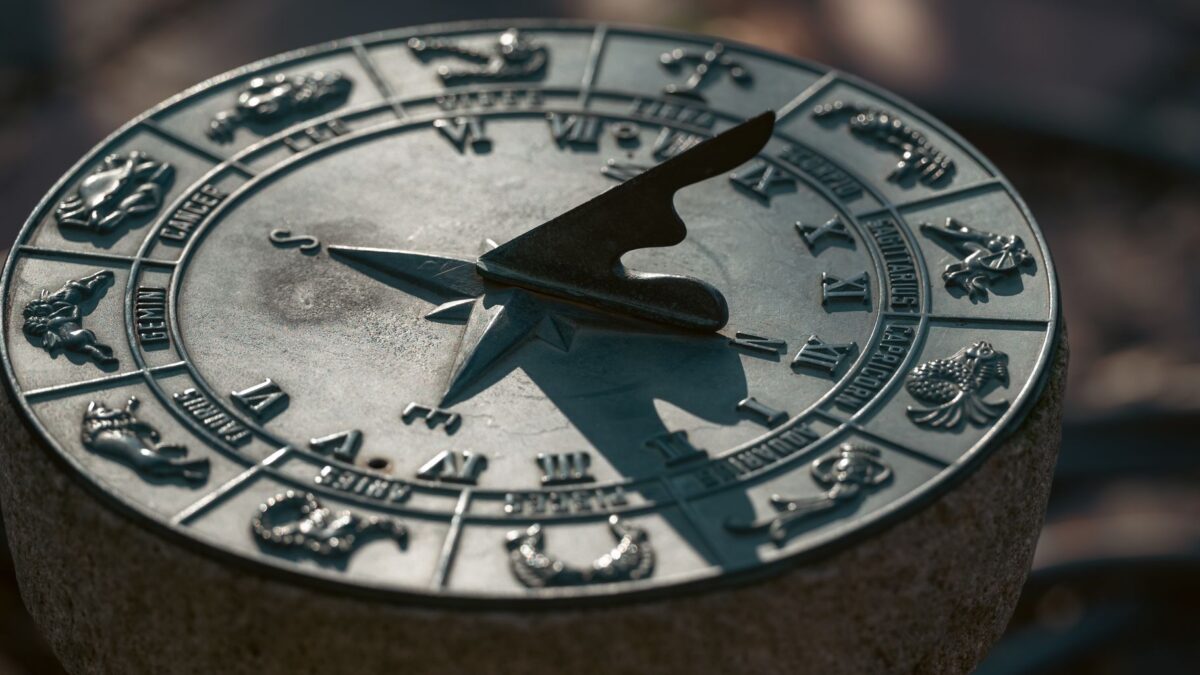
The crucial design secret of any accurate sundial is the gnomon’s angle. It cannot simply stand vertical; it must lie parallel to Earth’s axis of rotation. This means the gnomon must be tilted up from the horizontal by an angle equal to the local latitude and aimed toward true north in the Northern Hemisphere (pointing very close to Polaris) or true south in the Southern Hemisphere.
Aligned this way, the sun’s daily path around Earth’s axis sweeps the shadow across the dial plate at a steady angular rate throughout the day. Because Earth rotates 360 degrees every 24 hours, the sun appears to travel 15 degrees per hour across the sky. Setting the gnomon parallel to Earth’s axis ensures that this 15-degree-per-hour geometry projects consistently onto the dial plate regardless of the season.
This structural requirement explains why a sundial designed for Cairo (latitude ~30° N) reads incorrectly if moved to London (latitude ~51.5° N). If the gnomon angle does not match the local latitude, shadow speeds vary unevenly throughout the day as the sun’s seasonal path shifts north and south across the celestial equator. This is also why decorative garden-center sundials rarely tell accurate time: mass-produced dials frequently feature flat 45-degree gnomons or horizontal pins that ignore local geography entirely.
Major Types of Sundials
While all sundials rely on celestial geometry, historical makers adapted the concept into several distinct physical forms:

- Horizontal Sundials: The most familiar garden style. The dial plate sits flat on the ground or a pedestal, and the gnomon rises at an angle equal to the local latitude. Hour lines are spaced wider near noon and closer together toward sunrise and sunset.
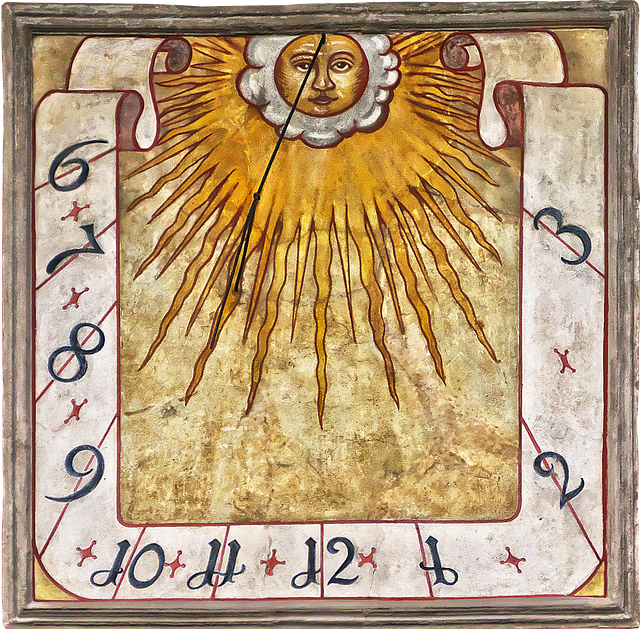
- Vertical Sundials: Mounted directly on south-facing building walls (in the Northern Hemisphere). The gnomon points downward at an angle equal to 90 degrees minus the local latitude.
- Equatorial Sundials: The dial plate is tilted parallel to Earth’s equator, and the gnomon stands perpendicular to the plate. Because the geometry mirrors the equator directly, hour markings are evenly spaced at exactly 15 degrees apart.
- Analemmatic Sundials: Flat horizontal dials placed in public parks where a human stands as the gnomon. The person stands on a central date scale marked for the current month to account for the sun’s changing seasonal declination, casting a shadow across a ring of hour markers.
- Portable and Ring Dials: Pocket-sized metal rings or folding boxes used by historical travelers, aligning shadow holes or fold-out gnomons against local latitude scales.
- Cathedral Meridian Lines: Giant indoor solar instruments built into church floors starting in the 15th century. A small aperture high in a south wall projects a pinhole image of the sun across a brass strip inlaid in the nave floor, marking the exact moment of solar noon.
Why Your Sundial Disagrees with Your Clock
Even a perfectly constructed, perfectly aligned sundial will rarely match the time displayed on a wrist watch or smartphone. A sundial measures local solar time, whereas modern society operates on standardized civil time. Converting local shadow time to civil clock time requires accounting for three distinct factors:
1. Longitude Offset
Civil time zones are standardized around specific reference meridians (such as 0° for GMT or 75° W for Eastern Standard Time). However, local solar time depends strictly on your exact local longitude. Because Earth rotates 360 degrees in 24 hours, the sun takes exactly 4 minutes to travel across 1 degree of longitude (15 degrees per hour).
If you live west of your time zone’s reference meridian, solar noon occurs after 12:00 PM civil time. If you live east of the reference meridian, solar noon occurs before 12:00 PM civil time. The correction formula is simple:
Longitude Offset (Minutes) = 4 × (Standard Time Meridian − Local Longitude)
2. The Equation of Time
Earth does not orbit the sun in a perfect circle, nor does it move at a constant speed. Due to Earth’s elliptical orbit (eccentricity) and its 23.5-degree axial tilt (obliquity), the real sun moves across the sky slightly faster or slower depending on the day of the year. This variation is known as the Equation of Time (EoT).
The Equation of Time causes true solar time to drift fast or slow compared to uniform clock time by up to 16 minutes throughout the year:
| Date (Approximate) | Equation of Time Effect |
|---|---|
| Mid-February | Sundial is ~14 minutes slow (behind clock) |
| Mid-April | Sundial matches mean clock time (0 minutes) |
| Mid-June | Sundial is ~4 minutes slow |
| Early September | Sundial matches mean clock time (0 minutes) |
| Early November | Sundial is ~16 minutes fast (ahead of clock) |
| Late December | Sundial matches mean clock time (0 minutes) |
Historical sundial makers often engraved a looping figure-eight diagram—the analemma—or a monthly lookup table directly onto the dial face to let users read this correction at a glance.
3. Daylight Saving Time
Civil clocks are shifted forward by 1 hour during summer months in many regions. Sundials operate strictly on natural celestial motion and do not adjust for local administrative decrees. During Daylight Saving Time, you must manually add 1 hour to the reading.
How to Read a Sundial: Step-by-Step Worked Example
To convert a shadow reading on a correctly set sundial into exact civil time, apply the following steps:
- Read the Shadow: Note the solar time indicated by the edge of the gnomon’s shadow on the dial plate.
- Apply Longitude Correction: Add 4 minutes for every degree you are west of your standard meridian, or subtract 4 minutes for every degree east.
- Apply Equation of Time: Subtract the EoT value if the sun is fast, or add it if the sun is slow (where EoT is defined as Solar Time − Mean Civil Time).
- Add Daylight Saving Time: Add 60 minutes if DST is currently active in your location.
Worked Example
Suppose you are located in Philadelphia, Pennsylvania (Longitude 75.16° W) on November 1. Your local time zone is Eastern Standard Time (Standard Meridian 75° W). You look at a true-north-aligned horizontal dial, and the shadow rests exactly on 1:00 PM (13:00).
- Base Shadow Reading: 1:00 PM (13:00) Solar Time.
- Longitude Offset: Philadelphia is 0.16 degrees west of the 75th meridian. Offset = 0.16 × 4 minutes = +0.64 minutes (+38 seconds).
- Equation of Time: On November 1, the Equation of Time is approximately +16.4 minutes (the sun is running ~16.4 minutes fast compared to mean solar time). Therefore, mean civil time is 16.4 minutes behind solar time.
- Calculation: 13:00 − 16.4 minutes + 0.64 minutes = 12:44:14 PM (12:44 PM EST).
Applying these adjustments brings solar shadow readings into agreement with atomic clock time to within a minute or two.
Setting Up and Aligning a Sundial
To ensure a sundial functions accurately, physical placement requires precision:

- Verify the Gnomon Angle: Ensure the gnomon angle relative to the dial plate matches your exact latitude. Adjust or shim the base if necessary.
- Level the Base: Use a spirit level to ensure the dial plate is perfectly horizontal in all directions.
- Find True North (Not Magnetic North): Compass needles point to magnetic north, which deviates from geographic True North by local magnetic declination. Look up your local magnetic declination or align the gnomon at solar noon when the shadow points directly along the XII hour line.
Common Problems and How to Fix Them
If shadow readings remain consistently incorrect after setup, evaluate these frequent issues:
- Fuzzy Shadow Edges (Penumbra): Because the sun is a disk rather than a point source of light, gnomon shadows have soft edges. Always read time from the center of the shadow line or the specific edge recommended by the manufacturer.
- Aimed at Magnetic North: Aligning a dial with a pocket compass without adjusting for magnetic declination causes systematic errors of 10 to 40 minutes depending on geographic location. Use true astronomical north.
- Seasonal Shadow Length Extremes: In high-latitude winters, low solar angles stretch shadows long across the plate; summer midday sun casts tiny shadows. Ensure the dial plate is wide enough to catch the gnomon tip year-round.
Who This Advice Does (and Doesn’t) Suit
Understanding sundial mechanics is ideal for gardeners, astronomers, architects, solar energy installers, and horology enthusiasts seeking to understand direct celestial geometry.
However, sundials are unsuited for precision scheduling, indoor environments, locations with frequent cloud cover, or regions at extreme northern latitudes (above 66° N) during winter polar night. Modern computer networks and synchronized devices rely instead on uniform timestamp protocols like Unix Time, which ignore solar position entirely in favor of steady, continuous seconds.
Grand Solar Architecture and Modern Legacy
The grandest historical sundials hide inside cathedrals. From the 15th century onward, cathedrals in Italy and France embedded meridian lines into their stone floors. A small hole high in a south wall projected the sun’s image across an inlaid brass line at exact solar noon, marking the date along the floor. Built to pin down the precise astronomical date of Easter, instruments like the meridians of Bologna’s San Petronio and Paris’s Saint-Sulpice turned entire cathedral naves into giant solar instruments.
The sundial’s legacy remains embedded in modern science. The analemma—the figure-eight shape printed on geographic globes—is simply a composite photograph of the sun’s noon position taken across a full year. Navigators relied on solar altitude measurements long after mechanical clocks matured. Today, solar-panel installers and architectural lighting designers use the exact same solar geometry to calculate optimal window placements, shadow profiles, and photovoltaic tilt angles.
The sun that drives every dial is the same celestial body whose rise, transit, and set times are calculated for any location in the solar panel tool at itsdately.com — solar noon there marks the exact moment a calibrated sundial’s shadow touches XII.
Sources: Sundial
Frequently asked questions
Why does a sundial shadow point north in the Northern Hemisphere?
Because the sun transits through the southern sky for observers north of the Tropic of Cancer, gnomon shadows cast opposite the sun fall toward true north at solar noon.
Can a sundial work at night?
Standard sundials require direct sunlight. However, historical makers crafted “moondials” (lunar dials) that calculate time at night using moonlight, requiring numerical correction tables based on the phase of the moon.
What is the difference between mean time and solar time?
Solar time measures time based on the actual position of the sun in the sky. Mean time is an idealized uniform time system based on the average length of a solar day (24 hours), smoothing out the seasonal fluctuations caused by Earth’s elliptical orbit and axial tilt.
Why do garden sundials often show the wrong time?
Most decorative garden sundials are manufactured with fixed 45-degree gnomons and are set up using magnetic compasses rather than true north. Without adjusting for local latitude, magnetic declination, longitude offset, and the Equation of Time, they can drift off by over an hour.
Related on itsdately: Before Mechanical Clocks: Water Clocks, Hourglasses, and Candle Time · The Oldest Working Clocks in the World · The Speaking Clock: When People Telephoned to Ask the Time
Further reading: North American Sundial Society