
- Today
- Friday, 30 October 2026 · ISO week 44 · day 303 of the year
Computed on every visit from the time-zone database and standard astronomical formulas, so these never go stale. The article below is unchanged.
The Salisbury Cathedral clock, built around 1386 in England, is widely recognized as the oldest working mechanical clock in the world. Operating without a dial to chime cathedral bells, it leads a rare group of surviving 14th- and early 15th-century timepieces that include Wells Cathedral, Rouen’s Gros Horloge, and Prague’s Orloj.
What defines the oldest working clock in the world?
Determining which timepiece holds the absolute title of “oldest working clock” depends on how horologists define a working mechanism. Mechanical timekeeping evolved rapidly in Western Europe during the late 14th century, but centuries of repairs, modifications, and relocations mean that almost no medieval clock remains entirely in its original state.

When evaluating these ancient machines, historians look at several distinct criteria:
- Continuous operation vs. restoration: Some movements have ticked continuously for six centuries, while others, like the Salisbury clock, sat dormant for decades before being restored to working condition in the 20th century.
- Original location vs. museum preservation: Clocks like Prague’s Orloj operate in the exact city square tower where they were installed in 1410. In contrast, the original 1390 movement from Wells Cathedral now operates inside London’s Science Museum, while its original dial in Somerset is driven by a 19th-century movement.
- Mechanical vs. water-powered design: Ancient civilizations built water clocks (clepsydras) thousands of years ago—such as Su Song’s 35-foot astronomical water tower built in China in 1092—but none of those ancient water-driven mechanisms have survived in continuous mechanical operation. The oldest surviving operational clocks are all weight-driven mechanical clocks built in Europe between 1380 and 1410.
- Substantial original gearing: Over hundreds of years, individual iron teeth, pinions, and balance bars wear down and are replaced. A clock is generally considered authentic if its primary structural iron frame and core gear train date back to its medieval construction.
The leading contenders for the world’s oldest working clock
A small group of European mechanical clocks built between 1386 and 1410 share the pinnacle of horological history. Each represents a major milestone in mechanical engineering and civic life.
Salisbury Cathedral Clock (c. 1386)
Located inside Salisbury Cathedral in Wiltshire, England, this large, hand-forged wrought iron frame clock has no dial, hands, or numbers. Its sole function was to strike a bell on the hour to signal services for the cathedral clergy and local townspeople. In medieval Europe, the word “clock” derived from the Middle Dutch and Old French words for bell (clokke and cloche), reflecting an era when time was heard rather than seen.
The movement uses a verge-and-foliot escapement housed within an open iron frame measuring roughly three feet square. Converted to a pendulum control system in the 17th century, the clock was abandoned in a cathedral tower when a new movement was installed in 1884. In 1956, horological restorers repaired the mechanism and rebuilt its original verge-and-foliot system. Today, visitors to Salisbury Cathedral can see the 1386 movement ticking steadily on the cathedral floor.
Wells Cathedral Clock (c. 1390)
Constructed shortly after Salisbury’s timepiece around 1390, the Wells Cathedral clock in Somerset introduced elaborate visual spectacle to timekeeping. Its famous astronomical dial depicts a geocentric view of the solar system, with Earth fixed at the center while the sun and moon rotate around it on concentric rings, displaying both time and lunar phases.
Above the main dial, a set of automated mechanical figures known as jousting knights charge each other every 15 minutes. During each joust, one knight is knocked backward off his horse—a mechanical performance that has repeated every quarter-hour for over 600 years. The original medieval movement was retired in 1884 and moved to London’s Science Museum, where it remains fully operational. The dial in Wells Cathedral continues to run using a replacement 19th-century movement.
Gros Horloge of Rouen (1389)
Installed in Rouen, France, the Gros Horloge features a mechanical movement forged in 1389 by Jourdain del Leche. Originally housed in a standalone bell tower, the clock mechanism was moved to span an ornate Renaissance archway over the Rue du Gros-Horloge in 1529. The movement is among the largest and oldest working wrought-iron clock mechanisms in Europe. Its massive double-sided dial display, added in the 16th century, features a single hour hand, a moon phase sphere at the top, and a rotating weekday disk decorated with allegorical figures.
Prague Astronomical Clock / Orloj (1410)
Mounted on the southern wall of the Old Town Hall in Prague, the Orloj is the oldest astronomical clock in the world that is still operating in its original physical location. Built in 1410 by clockmaker Mikuláš of Kadaň and astronomical professor Jan Šindel, the Orloj features an intricate dial that tracks solar time, lunar cycles, the position of the sun in the zodiac, and ancient Old Czech time (where hours are counted from sunset).
Every hour, crowds gather in Prague’s Old Town Square to watch the Walk of the Apostles, where figures of the twelve apostles parade past upper windows while a skeleton representing Death rings a handbell. Local folklore claimed the city council blinded the master clockmaker so he could never replicate his work—though historical archives show the clock survived through regular municipal maintenance, surviving heavy artillery damage during World War II in May 1945 before undergoing meticulous restoration.
Bern Zytglogge (1405 / 1530)
The Zytglogge tower in Bern, Switzerland, housed a clock mechanism starting in 1405. After a major fire, the current movement was built by Kaspar Brunner in 1530 and has operated continuously ever since. The clock features an astronomical dial and an automaton show featuring dancing bears, a crowing rooster, and Chronos flipping an hourglass. In the early 20th century, a young patent clerk named Albert Einstein watched the Zytglogge tower while commuting to work, using the synchronization of municipal tower clocks across Bern to inspire his special theory of relativity.
Comparing the world’s oldest operating mechanical clocks
| Clock Name & Location | Date Built | Current Location of Movement | Escapement Type | Primary Display / Feature |
|---|---|---|---|---|
| Salisbury Cathedral Clock (Salisbury, UK) | c. 1386 | Salisbury Cathedral (Original site) | Restored Verge & Foliot | Faceless bell striker; hand-forged iron frame |
| Gros Horloge (Rouen, France) | 1389 | Gros Horloge Arch, Rouen | Pendulum (converted) | Single-hand Renaissance dial with moon phase sphere |
| Wells Cathedral Clock (Wells, UK) | c. 1390 | Science Museum, London | Pendulum (converted) | Geocentric astronomical dial with jousting knights |
| Prague Orloj (Prague, Czechia) | 1410 | Old Town Hall, Prague (Original site) | Pendulum (converted 1865) | Oldest in-situ astronomical clock with animated figures |
| Bern Zytglogge (Bern, Switzerland) | 1530 (tower 1405) | Zytglogge Tower, Bern | Pendulum (converted) | Astronomical dial with performing bear automaton |
How medieval mechanical clocks kept time
Before the invention of balance springs or pendulums, 14th-century clockmakers relied on the verge-and-foliot escapement. This mechanical innovation was Western Europe’s first system designed purely to divide continuous rotary motion into equal, oscillating beats.
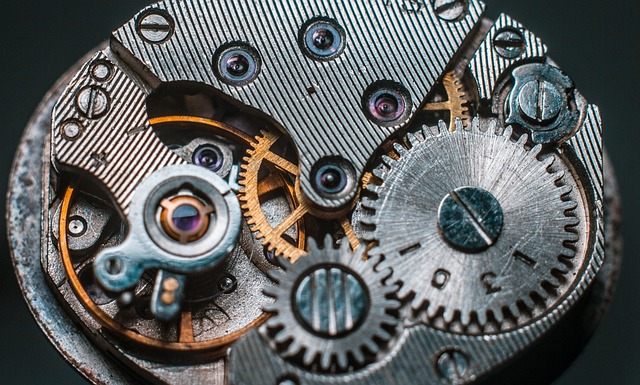
The mechanism consists of three core elements:
- The crown wheel: A vertical gear wheel with saw-like teeth pointing sideways, driven by a heavy falling stone or lead weight wrapped around a wooden barrel.
- The verge: A vertical iron staff fitted with two small metal flags or pallets positioned at right angles to each other. As the crown wheel turns, a tooth pushes against the top pallet, turning the shaft until the tooth slips off.
- The foliot: A horizontal bar mounted at the top of the verge staff with small weights suspended on either end. The momentum of the swinging foliot swings the verge back, bringing the lower pallet into the path of a crown wheel tooth on the opposite side, stopping the wheel and reversing the swing.
Because the rate of oscillation depended entirely on friction, weight positions, and gear alignment, verge-and-foliot clocks were remarkably inaccurate by modern standards. They frequently drifted between 15 and 30 minutes every day. Clockkeepers adjusted the timing daily by moving the small weights inward or outward along the foliot bar, referencing a cathedral sundial at solar noon to reset the clock.
In 1656, Dutch mathematician Christiaan Huygens invented the pendulum clock, which reduced timekeeping drift from minutes per day to seconds per week. Following this breakthrough, nearly every medieval clock across Europe was upgraded with pendulum conversions. Salisbury Cathedral’s unique historical status exists because restorers in the 1950s reversed those modifications, returning the iron frame to its original verge-and-foliot configuration.
Why these six-century-old machines survived
The primary reason these medieval machines still exist is not just iron metallurgy, but continuous human institutions. Private domestic clocks rarely survived multi-generational upheavals, but cathedrals and municipal governments maintained salaried clockkeepers across centuries of war, religious reformations, and urban expansion.
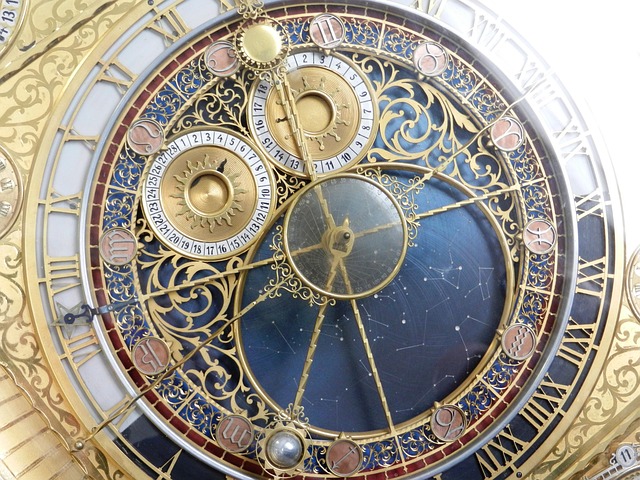
These dedicated keepers rewound heavy iron weights daily, replaced worn gear teeth, greased axles with tallow, and kept detailed accounting ledgers. The unbroken chain of physical maintenance proved far more durable than political regimes or national borders.
Modern timekeeping at itsdately.com relies on synchronized atomic clock standards accurate to nanoseconds, representing a dramatic shift from medieval iron gears. Yet both systems fulfill the same civic need that prompted cathedral chimes six centuries ago: establishing a shared reference of time for an entire community.
To explore more about how timekeeping evolved across history, see The Speaking Clock: When People Telephoned to Ask the Time, discover Why Do Clocks Run Clockwise?, or learn about long-term historic preservation in Time Capsules: Messages Scheduled Centuries Ahead.
Frequently asked questions
What is officially the oldest working clock in the world?
The Salisbury Cathedral clock, constructed in England around 1386, is widely recognized as the oldest surviving mechanical clock still operating today. While its movement was restored in the 20th century, its hand-forged iron frame and gear train remain substantially original.
Why do the oldest mechanical clocks have no clock faces or minute hands?
Medieval clocks were designed primarily to ring heavy bells for church services and city curfew rather than to display time visually, deriving their name from the word for bell. Because verge-and-foliot escapements drifted up to half an hour per day, minute hands were useless until the pendulum was invented in 1656.
What is the oldest operating astronomical clock still in its original location?
Prague’s Orloj astronomical clock, mounted on the Old Town Hall in 1410, holds the record for the oldest astronomical clock still operating in its original position. It features astronomical dials, moving mechanical figures, and animated hourly displays that have run for over 600 years.
Are there ancient water clocks older than medieval mechanical clocks?
Water clocks existed in ancient Egypt, Greece, Rome, and China thousands of years before mechanical clocks, including Su Song’s 1092 astronomical tower clock in Kaifeng. However, none of those ancient liquid-driven devices have survived in operational condition, leaving 14th-century European weight-driven iron clocks as the oldest working timepieces today.

About Yasir Hafeez
Yasir Hafeez is the creator of itsdately a free, independent site for clear world time, calendars, and date tools.