
This guide explains why the moon changes shape in plain language, with the exact figures and how to work them out yourself.
- Moon tonight
- Last quarter — 63% lit
- Next new moon
- 9 November 2026 at 07:03 UTC
- Today
- Saturday, 31 October 2026 · ISO week 44 · day 304 of the year
Computed on every visit from the time-zone database and standard astronomical formulas, so these never go stale. The article below is unchanged.
The Core Geometry: Why the Moon Seems to Change Shape
Start with the fact that fixes every misconception: the sun always illuminates half of the moon, exactly as it always illuminates half of Earth. The phases are not the moon being partly “switched off,” and — the most common myth — they are not Earth’s shadow. Earth’s shadow touches the moon only during a lunar eclipse, a few times a year at most. The phases are simply geometry: as the moon orbits us each month, we view its permanent day side from constantly changing angles.
Because the moon shines entirely by reflected sunlight, its appearance from Earth depends on the relative position of three celestial bodies: the Sun, Earth, and the Moon. When the moon is positioned between Earth and the sun, its illuminated hemisphere faces directly away from us. As the moon progresses along its counterclockwise orbit (viewed from above Earth’s North Pole), an increasing fraction of its lit half becomes visible to terrestrial observers, creating the progressive phases from thin crescent to fully illuminated disc.
The Eight Primary Phases in Sequence
Follow one complete cycle. The lunar cycle is continuous, but astronomers divide it into eight distinct phases based on the moon’s angular separation from the sun (elongation) measured from Earth:
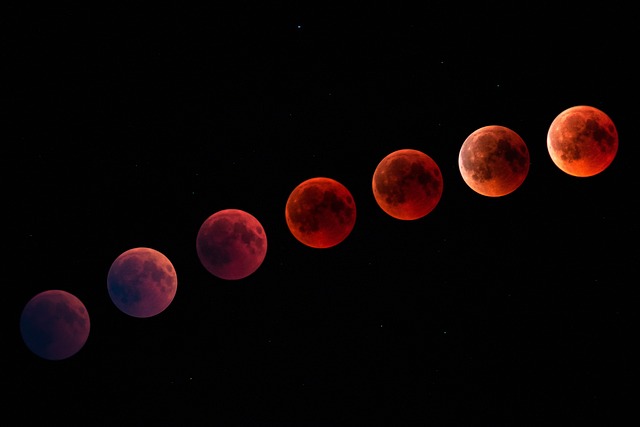
- New Moon (0° elongation): The moon sits roughly between Earth and sun; its lit half faces away, and we see nothing — it also rises and sets with the sun, hiding in daylight.
- Waxing Crescent (1° to 89° elongation): A few evenings later a waxing crescent hangs in the western dusk. The illuminated portion grows daily, appearing as a thin sliver whose outer curve faces toward the setting sun.
- First Quarter (90° elongation): Half-lit to our eyes, a quarter of the way around the orbit, this phase rides high in the sky at sunset. The eastern half of the visible disk is lit, while the western half remains dark.
- Waxing Gibbous (91° to 179° elongation): The illuminated surface swells beyond half full but is not yet completely round. It dominates the evening sky, rising in the late afternoon.
- Full Moon (180° elongation): The moon stands directly opposite the sun in our sky — which is why a full moon always rises at sunset and sets at sunrise, without exception. Its entire Earth-facing hemisphere is fully illuminated.
- Waning Gibbous (181° to 269° elongation): The sequence reverses as illuminated surface area begins to shrink (“wane”). The eastern edge goes dark first, and the moon rises progressively later in the evening.
- Last Quarter (270° elongation): The opposite half of the moon is lit compared to First Quarter. The moon now rises at midnight and stands highest in the southern sky at dawn.
- Waning Crescent (271° to 359° elongation): A thinning curve visible in the dawn sky shortly before sunrise, with its horns pointing westward, away from the morning sun.
Phase Mechanics and Viewing Schedule
The table below breaks down the eight standard phases, including the moon’s angular position relative to the sun, illumination fraction, and standard rise and set times:
| Phase Name | Solar Elongation | Illuminated Fraction | Typical Rise Time | Typical Set Time |
|---|---|---|---|---|
| New Moon | 0° | 0% | 6:00 AM (Sunrise) | 6:00 PM (Sunset) |
| Waxing Crescent | 45° | 1% – 49% | 9:00 AM | 9:00 PM |
| First Quarter | 90° | 50% | 12:00 PM (Noon) | 12:00 AM (Midnight) |
| Waxing Gibbous | 135° | 51% – 99% | 3:00 PM | 3:00 AM |
| Full Moon | 180° | 100% | 6:00 PM (Sunset) | 6:00 AM (Sunrise) |
| Waning Gibbous | 225° | 99% – 51% | 9:00 PM | 9:00 AM |
| Last Quarter | 270° | 50% | 12:00 AM (Midnight) | 12:00 PM (Noon) |
| Waning Crescent | 315° | 49% – 1% | 3:00 AM | 3:00 PM |
Worked Example: Why 27.3 Days Equals a 29.5-Day Cycle
The rhythm’s mechanics explain everyday astronomical puzzles. A common source of confusion is the difference between two distinct lunar periods: the sidereal month and the synodic month.
The sidereal month is the moon’s true orbital period relative to fixed background stars, taking 27.32166 days (roughly 27.3 days). However, the human phase cycle — the synodic month — lasts 29.53059 days (roughly 29.5 days). Why does it take over two extra days for the moon to complete its phase cycle?
We can work out the exact mathematical difference through Earth’s simultaneous orbit around the sun:
- Earth’s orbital speed: Earth completes a 360° orbit around the sun in roughly 365.256 days. This means Earth travels about 0.9856° along its orbit each day (360° ÷ 365.256 days).
- Moon’s orbital progress: In one sidereal month (27.32166 days), Earth travels about 26.92° around the sun (27.32166 days × 0.9856°/day).
- The realignment gap: Because Earth moved forward by 26.92°, the line connecting Earth and the sun has shifted. When the moon completes its 360° loop around Earth, it is not yet aligned with the sun again. It must travel an additional 26.92° to catch up to the shifted Sun-Earth line.
- Relative motion calculation: The moon orbits Earth at a rate of 13.1763° per day (360° ÷ 27.32166 days). Its rate of angular gain over Earth’s orbital progress is 13.1763° − 0.9856° = 12.1907° per day.
- Final result: To cover the full 360° cycle of relative solar alignment, it takes 360° ÷ 12.1907° per day = 29.5306 days (29.5 days).
Tidal Locking and the “Dark Side” Myth
The same orbital geometry explains why Earth observers always see the exact same lunar face. The moon is tidally locked to Earth. Over millions of years, Earth’s gravitational gradient exerted tidal friction on the moon, slowing its rotation until its rotational period precisely matched its orbital period around Earth (1:1 spin-orbit resonance).

Because the moon rotates once on its axis in exactly 27.3 days — the same time it takes to complete one orbit around Earth — the same hemisphere remains perpetually facing Earth. This means there is a “far side” of the moon, but there is no permanent “dark side.” During the New Moon phase, when the side facing Earth is dark, the far side is fully illuminated by the sun.
The Crescent Sun-Pointer and Geographic Variations
One elegant detail: the crescent’s horns always point away from the sun, and the lit side is a literal sun-pointer in the sky. If you draw an imaginary line extending through the crescent curve, it points straight down toward the horizon where the sun is located below.
However, the orientation of this crescent varies dramatically depending on the observer’s latitude on Earth:
- In the Tropics: The ecliptic (the path the sun and moon travel across the sky) meets the horizon at a steep, nearly vertical angle. As a result, a waxing crescent crescent moon appears to lie on its back like a boat or a bowl (often called a “wet moon” or “Cheshire cat moon”).
- At High Latitudes (Mid-Northern or Mid-Southern): The ecliptic cuts across the horizon at a shallow angle, causing the crescent to stand almost upright on its side.
- Hemisphere Flipping: Observers in the Southern Hemisphere look north toward the equator to view the moon, whereas Northern Hemisphere observers look south. Consequently, the apparent orientation of the illuminated crescent flips: in the Northern Hemisphere, waxing light fills from right to left; in the Southern Hemisphere, light fills from left to right.
Tonight’s exact phase, illumination percentage, and position in the 29.5-day cycle are computed live in the moon widget at itsdately.com — geometry, updated by the minute.
Why Eclipses Do Not Happen Every Month
One question the geometry raises: if the moon passes between Earth and sun every month, why isn’t every new moon a solar eclipse?
Because the moon’s orbit is tilted about five degrees (5.14°) relative to the ecliptic plane (Earth’s orbital plane around the sun), the alignment is usually a near-miss — the moon’s shadow passes above or below Earth during New Moon. Similarly, Earth’s shadow passes above or below the moon during Full Moon.
Eclipses can occur only when the moon crosses Earth’s orbital plane at specific intersection points called nodes. When a New Moon or Full Moon occurs precisely near one of these nodes, alignment is exact. These geometric alignments happen during “eclipse seasons” roughly twice a year: solar eclipses at New Moon and lunar eclipses at Full Moon — the exception that proves the phases’ rule.
Common Observational Misconceptions and Troubleshooting
1. “Why can I see the moon during the day?”
The moon is bright enough to be seen in the daytime sky during almost all phases except New Moon (when it is too close to the sun) and Full Moon (when it is on the opposite side of Earth from the sun). Because the moon is an opaque rock illuminated by intense sunlight, its surface brightness easily exceeds the sky background during morning or afternoon hours, especially at First and Last Quarter phases.

2. “Why does the moon rise at different times each night?”
The moon rises on average about 50 minutes later each day. Because the moon travels counterclockwise around Earth while Earth rotates on its axis in the same direction, Earth must rotate an extra ~13° (taking roughly 50 additional minutes) each 24-hour cycle to bring the moon back into view above the local horizon.
3. “Does this general phase timing apply at the Earth’s poles?”
The standard rise-and-set timing rules (such as Full Moon rising precisely at 6:00 PM) do not suit observers at extreme polar latitudes (above 66.5° N or S). At the North and South Poles, the concepts of daily moonrise and moonset break down due to extreme seasonal tilt; instead, the moon remains above the horizon continuously for roughly two weeks at a time, then stays below the horizon for two weeks.
Human Systems and Practical Applications
The cycle leaves fingerprints across human systems: the words “month” and “moon” share a root in most Germanic languages, lunar calendars from the Islamic to the Hebrew to the Chinese still schedule half the world’s holidays by the crescent, and fishermen, gardeners, and photographers all plan by phase — the full moon for light, the new moon for dark skies and stars.
Even ocean tides obey this celestial geometry:
- Spring Tides (Maximum Tidal Range): At New Moon and Full Moon, Earth, Sun, and Moon align in a straight line (syzygy). The gravitational pull of the sun combines with the pull of the moon, producing higher high tides and lower low tides.
- Neap Tides (Minimum Tidal Range): At First Quarter and Last Quarter, the Sun and Moon sit at right angles (90°) relative to Earth (quadrature). The solar gravitational attraction partially cancels out the lunar pull, producing lower high tides and higher low tides.
Frequently asked questions
What is the primary cause of moon phases?
Moon phases are caused by changing viewing angles. As the moon orbits Earth every 29.5 days, we see varying amounts of its sunlit half depending on the relative positions of the Sun, Earth, and Moon.
Is the moon’s phase caused by Earth’s shadow?
No. Earth’s shadow only touches the moon during a lunar eclipse. Regular moon phases are simply our perspective of the moon’s own daytime and nighttime hemispheres from Earth.
Why do we see the moon during the daytime?
The moon reflects enough sunlight to overcome atmospheric daytime brightness. Except during Full Moon (visible only at night) and New Moon (too close to the sun), the moon spends half its cycle in the daytime sky.
How much later does the moon rise each day?
The moon rises an average of 50 minutes later each day because it moves roughly 13 degrees along its orbit every 24 hours, requiring Earth to spin a bit further to catch up.
Related on itsdately: Why Are There 60 Seconds in a Minute? Blame Babylon · What Is an Equinox? The Two Days the Sun Crosses the Equator · What Is a Solstice? The Longest and Shortest Days Explained
Further reading: U.S. Naval Observatory Astronomical Applications.